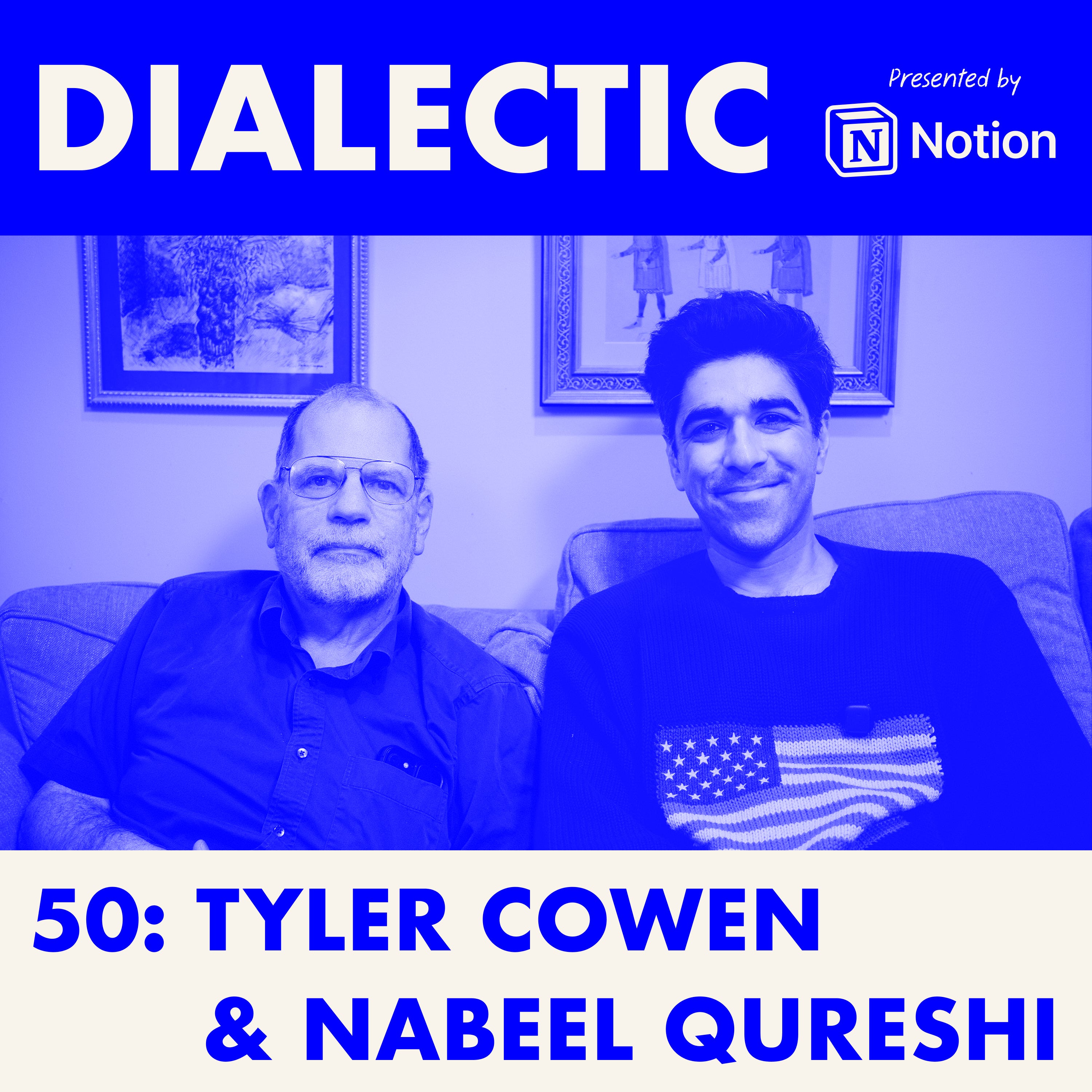
You could talk to Tyler Cowen & Nabeel Qureshi about anything and it would be interesting.
Nabeel is a former guest and a true polymath who can go wide and deep. He’d long suggested I interview his friend and mentor Tyler: the epitome of that archetype.
I wanted to do something special for 50, so I paired them together and hoped for some magic. I think we got some, and a few laughs, too.
Despite their day jobs, Tyler and Nabeel are unlikely aesthetes who became friends in part through their shared love of film and art.
So I spoke to them about how great art is often strange, aesthetic evolution, and a tour through some of their favorite artists (especially musicians).
We also discussed sacred commitments, AI acceleration, good group chats, mentorship, whether Tyler will stop writing books, creating a bat signal for talent, becoming a great interviewer, Twitter’s virtues, New York City, and more.
19 favorite lessons/ideas below. Please enjoy and share!
Also, some thoughts on 50 episodes. Thank you for all of your support :)
Dialectic Ep. 50: Tyler Cowen & Nabeel Qureshi - An Appetite for More
19 Lessons from Tyler Cowen and Nabeel Qureshi on AI, Strange Beauty, Mentorship, and The Appetite for More
It’s the first inning, sir. Tyler looks at AI and sees a race that may never get settled. One conclusion: maintain your stamina. When someone tells Nabeel they’re tired, his answer is simple and unsentimental: “pace yourself.”
Fear the Wall Street AIs, not the current crop of pets. Tyler thinks AI’s are trending toward behaving like helpful pets, eager to cooperate and wag like his dog Spinoza. The scarier systems are the ones trained outside that domestic pressure, in markets, war, or stranger open-source corners.
You don’t control a mind, you raise one. Nabeel’s long view on AI safety is that clamping down on outputs misses the point because, at the limit, these things become other people. You don’t keep a child in line with rules; you teach them values, morals, religion, and—possibly—how to love.
Send your missionaries to the AI labs. Nabeel jokes that if he were more religious, he’d camp outside the labs and get his brightest young people hired there. Religious values might be one of the few proven “technologies” for making intelligence behave in a moral way.
AI makes the right handshake more valuable. Most people see AI acceleration and imagine replacement. Nabeel sees leverage. If the tools can automate output, the right deal can unlock much more than before. The more powerful the machine, the more valuable the human act of choosing who to trust, what to build, and where to point it.
Markets compound virtue; they don’t create it. Markets are powerful accelerants, but they need something to accelerate. Tyler thinks they can reward and reinforce virtue but not summon it from nothing. Nabeel’s (and Will Manidis’) deeper worry is that commerce once built on a foundation of religion, character, and sacred commitment may now have a hollow center.
Great work demands conviction. We need something to believe in. New aesthetics don’t require optimism, but they do need a strong point of view. Religion can provide one. Nihilism can too. The danger is not pessimism exactly; it is making things from no center at all. An aesthetic ought to express a way of living.
Your deep thoughts might be the shallow part. Nabeel calls Tyler an “exterior person:” writing, traveling, looking, collecting, pushing things into the world. Tyler accepts the charge. He is suspicious of too much introspection and thinks his so-called superficial urges may be more real than his deep thoughts. Even influence gets treated this way: chase it directly and you probably end up with less of it.
We like beauty with a strange shape. Tyler finds pure beauty a little boring. You can’t have ice cream all the time. Nabeel says the art that lasts tends to destabilize us and keep us wanting. They suggest the long outro of Venice Bitch, the changing time signatures in Happiness Is a Warm Gun, or the scary parts of Beethoven’s Sixth. They want something they can’t quite solve: Aphex Twin defies the EDM genre’s consistent patterns, My Bloody Valentine makes no sense on first listen, and difficult films have an aftertaste that demands revisiting.
Time spent is its own kind of criticism. Tyler half-believes museum guards understand art better than critics because they simply spend more time with the work. The uneducated people he met in rural Mexico talked about the work more thoughtfully than we do. Context matters, but so does exposure.
Simplicity may be complexity, disguised. The Beatles sound simple until you listen closely. Tyler hears (and George Martin enabled) strange modulations, interwoven vocals, backwards piano, bass lines, harmonies, and unlikely choices. I’m reminded of Jerry Seinfeld: “all art is disguising work.”
Borrow better taste until it becomes yours. Nabeel learned from Tyler by trusting his judgment before he understood it. As former guest Tammy Winter says, find people you admire and follow them into work you don’t yet understand. Or as Charles Broskoski reminds us: you can fake it ‘til you make it. Sometimes the first step toward liking difficult art is believing that someone ahead of you has found something there.
Listen to the internet’s chords, not a single note. A single tweet is meaningless, but Twitter is a miracle. Tyler calls it one of mankind’s greatest creations and a “grand organ”: intellectual, funny, depressing, generative. Context, in concert.
A performed plan beats no plan. A key question Tyler asks the young people he funds is: what’s your plan for follow-up funding? Most of them fumble it. He doesn’t even mind if they’re gaming the answer, because a contrived plan still gets you moving.
Be mentored from below. Tyler has an abundance mindset with mentors. You’ll never outgrow the need, and more of them should be younger than you. Nabeel keeps meeting people in their early twenties who are sharper than him at specific things, and says the hard part is keeping your ego low enough to learn. Nabeel mentors Tyler in movies, music, AI, and tech; Tyler mentors Nabeel in taste, judgment, and appetite for experience.
Talent is context-dependent. Nabeel noticed that Palantir’s top performers were not automatically the best future founders. Some people dominate the company game; others need a different arena before their spike becomes obvious. Some kinds of agency only appear in the right game.
The two-year book can’t keep up with the one-week world. Seventeen books in, Tyler may be nearing the end of writing them because a two-to-three-year cycle feels too costly when the world changes weekly. Nabeel hates the take because he still believes a book can carry the judgment of a mind no model can replace. The tension is the lesson: some forms preserve depth because they move slowly.
Don’t hit your quota on friendship. Most people have fewer friendships as they age. Tyler aims for the opposite: keep the network alive, keep the group chats moving, keep encountering people who expand your world. “No new friends” would be a tragedy.
Maintain an appetite for more. Nabeel admires Tyler for never getting stuck in his ways and growing more himself with age. Tyler admires Nabeel for having such great—and unlikely—taste. One can’t stop becoming; the other can’t be explained.
Description
Tyler Cowen (Website, X, Marginal Revolution, Conversations with Tyler) is an economist at George Mason University, leads the Mercatus Center, and is the author of many books including The Great Stagnation and *Average Is Over.* He has blogged nearly daily at Marginal Revolution for over 20 years, has interviewed hundreds of world-experts on *Conversations with Tyler,* and runs Emergent Ventures, a prolific grants program that has funded multiple Dialectic guests.
Nabeel Qureshi (Website, X, Substack) is an entrepreneur, writer, and researcher. He runs a stealth startup. Previously, he was a Visiting Scholar at Mercatus and spent nearly eight years at Palantir. He writes some of my favorite essays, including “What Makes Art Great” and “Rented Virtue”, and was previously a guest on Dialectic for episode 13: “The Will to Care.”
Tyler and Nabeel are good friends, and given how prolific Tyler is, I decided to use Nabeel as an entry point and interview them together. We discuss sacred commitments, AI acceleration, mentorship, friendship, and more, but I focused the majority of the conversation on art and aesthetics. Tyler and Nabeel are unlikely aesthetes given their day jobs, but in fact take art deeply seriously. They have a shared love for and similar tastes in art, music, and film, in particular. We discuss strange and beautiful art, aesthetic stagnation, and a wide range of favorites: The Beatles, Mozart, Mondrian, Springsteen, Lana Del Rey, Kanye West, Cassavetes, The Sopranos, Apichatpong Weerasethakul, and more.
Please enjoy, and thank you for supporting, listening, and watching through fifty episodes of Dialectic. I can’t wait for the next fifty!
Dialectic is presented by Notion. Notion is an AI-powered connected workspace where teams think together and create their best work. Learn more about Notion’s new developer platform and workers here. You can learn more at notion.com/dialectic.
Timestamps
(0:00) Opening Highlights
(1:18) Intro to Tyler & Nabeel
(3:02) Thanks to Notion
(4:38) Start: Sacred Commitments, AI, Markets, and Acceleration
(20:23) How Art Moves Us
(27:08) “Beauty,” Strangeness, Great Art, Music, and The Beatles
(44:09) Film, Critics, Learning to Appreciate Depth, More Music, “Lowbrow” Art
(1:02:25) New Aesthetics, Sources of Inspiration, Optimism & Pessimism
(1:11:22) The Internet & Twitter’s Virtue, Group Chats, and Cities
(1:21:35) Mentors, (Possibly Quitting) Writing Books, Friendship
(1:34:54) Interviewing, Identifying Talent, and Agency
(1:47:21) Closing Questions
(1:53:38) Thanks Again to Notion