


Jasmine Sun quit her tech job to tell the world about what she’s seeing up close in Silicon Valley.
I talked to her about the depth behind SF’s memes, why quitting her job wasn’t risky, and her “AlphaGo” moment--and why she’ll keep writing anyway.
Jasmine writes independently here on Substack--where she used to lead core product--and for publications like The Atlantic and The New York Times.
Some select pieces of hers:
‘Chinese Peptides’ Are the Latest Biohacking Trend in the Tech World (NYT)
Claude code psychosis (Substack)
Notes on AI, labor, and China (Substack)
America against china against america (Substack) - my favorite!
The Human Skill That Eludes AI (The Atlantic)
20 favorite lessons below. Links: Transcript & all links, Spotify, Apple, YouTube, X/Twitter.
Dialectic 49: Jasmine Sun - Close Enough to See Clearly
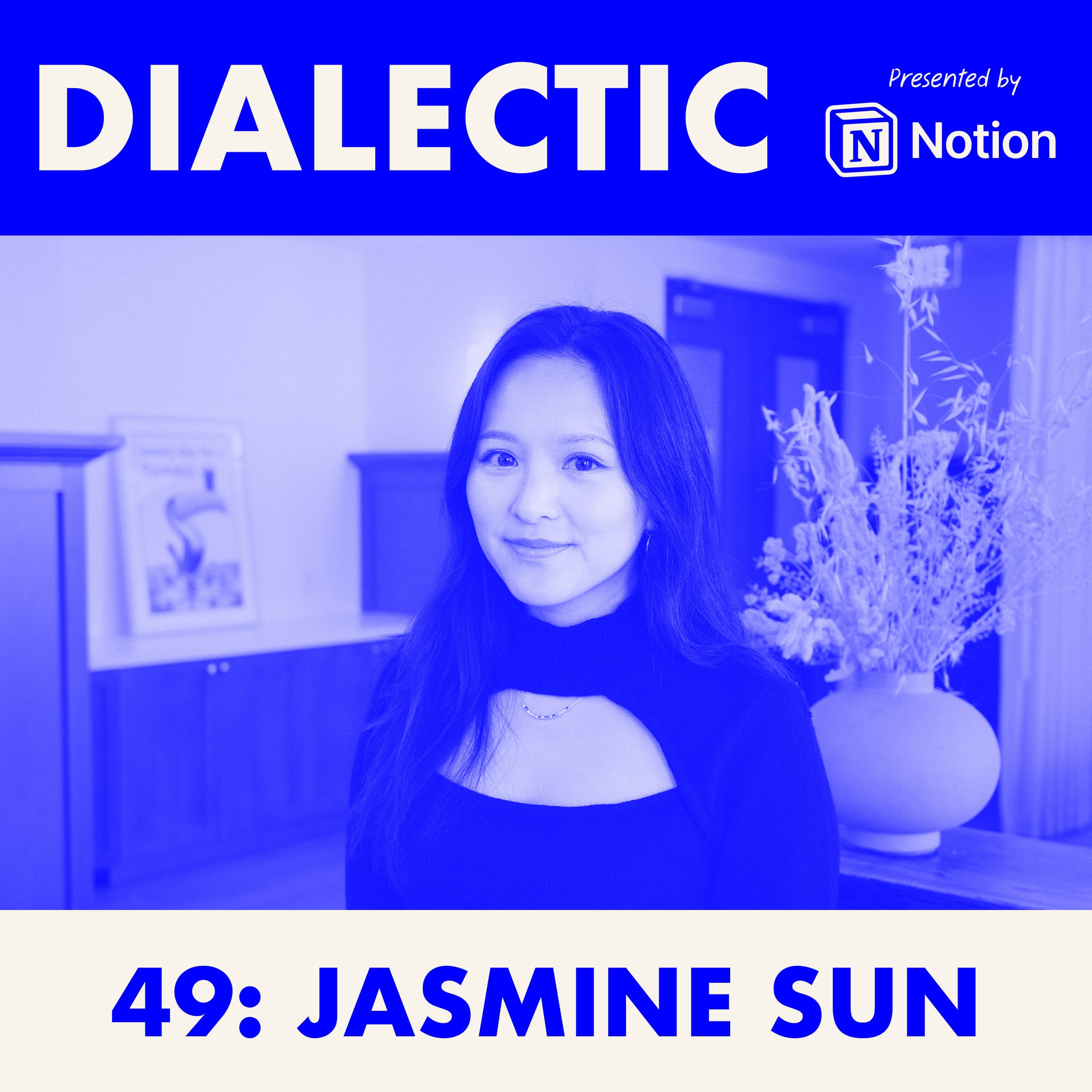
21 Lessons from Jasmine on Seeing & Reporting, Shaping Your Writing, and Staying Human as the Machines Close In
On Seeing and Reporting
Look for clarity before you judge. Jasmine is a naturally judgmental person who decided she didn’t like who that made her. She decided to focus on observation, inspired by Sontag: “the critic’s first duty is to explain, not to evaluate.”
Admire the world for never ending on you. Annie Dillard’s line reminds Jasmine that almost anything can be interesting. She had no interest in peptides until a month of reporting turned gray-market vials from China into a story about medical distrust, biohacking, Reddit, ChatGPT, and supply chains. Few things are boring, only insufficiently examined.
Look for the truth behind the meme. Chinese memes about “work smell,” 996, and “code farmers” are how a culture with heavy speech censorship channels real anxiety about unemployment and nihilism. The “permanent underclass” meme is hyperbole too, but she reported it because friends in San Francisco were making actual career decisions on it, convinced that without a frontier-lab job they’d be poor forever.
Pitch the question, not the answer. Jasmine sells editors on stories she genuinely can’t answer yet, then runs 25 interviews before forming a strong opinion. She tells each source up front she isn’t fishing for a quote, she just wants to think through it with them. Her logic is simple: “if I had the angle, I wouldn’t be writing it.”
You have to care for something to see it clearly. Jasmine is close enough to Silicon Valley to know the people, the language, and the private fears. She also takes great effort to maintain enough perspective to report on it honestly for outsiders. That tension, and her care to understand tech and have it be understood, is what makes her a great translator.
Silicon Valley only talks to itself. Tech aims its message at recruits, investors, researchers, and enterprise buyers, not the broader public. That insular culture combined with a truly unusual set of values produces a strong disconnect. The same message that works on the in-crowd can sound alien to people who do not want to live forever, stop working, or carry an AI Terence Tao in their pocket.
Proximity is the credential. Few journalists actually live in San Francisco, which Jasmine finds absurd for a center of power and wealth. When you’re in the rooms and at the happy hours, you feel the temperature rise on a story before a NY desk can, and it builds the kind of trust where sources give you their side instead of bracing to be burned.
On Shaping Your Writing… and Life
Polish no longer proves human effort. Perfect grammar and house style once thanked a meticulous editor. Now, a fine-tuned model spits out flawless New York Times style from a pile of crappy notes. Effort’s signals are now voice, weirdness, and that sweet, sweet je ne sais quoi a machine can’t fake.
Serious work is a bat signal. Pour yourself into a piece and strangers pour themselves back. After Jasmine’s 7,000-word China piece, readers sent her essay-length emails about their own lives, one recalling the skyscrapers of his youth “sprouting up like mushrooms.” Writing, to her, is a kind of proof of work, and the world replies with the seriousness you put in.
Don’t LARP someone else’s voice... or taste. Jasmine can tell when a writer is wearing a borrowed style, trying to be Didion or Wallace without having lived what they lived. It’s like wearing your mom’s high heels as a kid. Her quarrel with taste discourse is that it pushes people to shop for a personality from a catalog of cool, when the actual work is turning inputs into a point of view only you could have.
Stop apologizing for your own existence. Jasmine’s early essays hedged every other sentence because she graded each one against the most expert friend she could imagine. She realized she actually writes for a smart reader who isn’t the world’s leading expert, and that good work doesn’t constantly hedge.
It probably just isn’t that risky. Leaving a senior product job at Substack looked reckless, but wasn’t. She had a year of runway, a fallback job she could walk back into, and enough savings to last a year. A one-year trial with exit criteria she passed with flying colors. The leap is usually smaller than the story we tell about it.
There’s more than one kind of capital. Jasmine took a large pay cut and isn’t too worried, because she thinks money is the easiest capital to build. Attentional, social, and cultural capital are harder, and she’s stacking them now, confident she can convert them to cash when she needs to. As she puts it, knowing how to turn it into financial security is enough financial security for now.
Agency still rocks. Jasmine believes Silicon Valley’s chief virtue is a justified cliché: agency. It insists that a future exists and that regardless of your qualifications, you can build it. After older journalists told her all was doomed, a house of Thiel Fellows in Cancún convinced a young Jasmine that she really could be a writer and introduced her to her first funders. You really can just do things.
On Staying Human
The only question AI can’t answer for you: will you lie to yourself? At the gym you know whether you really pushed the weight, and no lie makes you stronger. AI is the same test under harder conditions, because it’s flawless at manufacturing the illusion of thinking, of productivity, of every idea being good. We’re all going to face the private challenge of being honest with ourselves: knowing whether we actually thought, actually learned, actually cared.
Choose what’s worth doing for its own sake. A machine already beat the best human alive at Go, and people kept playing. Jasmine thinks this is a template for the rest of the AI age, and she points to C. Thi Nguyen’s Games: Agency as Art: you play a board game to exercise your own agency, not to win money or advance your career. It’s the same reason she keeps writing as AI improves, because writing makes her smarter and kinder, and that is reason enough. Each of us will have to decide what we’d still do once a machine does it better.
The real world is all edge cases. Jasmine thinks we should feel lucky that one-shotting every job is so hard. The org chart is never the real org chart; the standard procedure gets followed maybe 80% of the time, and that other 20% is a flood of tacit knowledge nobody ever wrote down. That specific illegibility buys us time to rage against the machines.
The short run can be a lifetime. Jasmine keeps returning to Carl Benedikt Frey’s line because it punctures the easy optimism around technological transition. Even if the long-run story AI leaders tell is abundance, the adjustment period can consume entire lives for the people caught in it.
Spend the windfall on the people we want in the room. Jasmine’s sketch of a good AI future: tax the windfall, hire ten times as many teachers, pay them double, and give every kid an Oxford-style tutor who actually knows them. It’s a rare vision of a transition that sounds deeply humane. I’m long relational goods.
A flawless robot would never move you. What makes us cry watching Alysa Liu isn’t the technical excellence. It’s knowing about her father, her quitting, her coming back to skate for herself. Jasmine’s made peace with the day AI out-writes her because the thing she is sharing isn’t the prose, but proof that one specific person was here.
Earnestness is good for the soul. Jasmine keeps colliding with the Silicon Valley reflex of “screw you, I don’t care what you think,” and it bothers her more than almost anything. Bothering to be liked, to be understood, to make your case to people who didn’t ask, is a virtue and not a weakness. Detachment eventually becomes a way of refusing your own life.
Description
Jasmine Sun (Substack, X, LinkedIn) is an independent writer and journalist. She is a contributing writer for The Atlantic and also writes for other major publications, like The New York Times. She previously led core product at Substack.
Jasmine focuses on Silicon Valley and AI, and is something of a participant observer, living among the strange and inspiring people pulling the future forward in San Francisco. In her writing, she plays to both sides: focusing on a more endemic audience with her newsletter while telling the broader world about what she learns in flagship pieces for major publications. Several of these anchor around memes that she thinks may deeply matter: “the permanent underclass,” “chinese peptides,” and “claude code psychosis,” to name a few.
Jasmine has done many interviews about these individual topics, so I wanted to focus on her and her approach: playing to both audiences, her taste in questions and topics, doing both “serious” journalism and more personal writing, how going independent wasn’t so risky, what she admires in great writing, AI and her coming “AlphaGo moment,” China, and more. Please enjoy.
Dialectic is presented by Notion. Notion is an AI-powered connected workspace where teams think together and create their best work. Learn more about Notion’s new developer platform and workers here. Check out Brian’s X/Twitter sync worker. You can learn more at notion.com/dialectic.
Timestamps
(0:00) Opening Highlights
(1:30) Intro to Jasmine
(2:13) Thanks to Notion
(3:24) Start: Being a “Historian of Vibe” and Learning to Look
(15:00) Taste for Questions & The Depth Behind Memes
(24:28) Translating Between Silicon Valley and The World
(40:27) Substack vs. “Serious” Journalism and Integrity as a Writer
(47:35) Integrity when Using AI and the AlphaGo Question
(58:42) Strategy Across Publications & Maximizing an Idea’s Reach
(1:06:45) Going Independent, Risk, and Commercial Tradeoffs
(1:24:35) Great Writing: Style, Voice, and Resisting Summary
(1:35:35) Literary Inspirations, Favorite Essays, Writing vs. Thinking, and Getting Better
(1:51:09) Writing to Publish, Authenticity, and Art
(2:00:38) Grab Bag: China, Silicon Valley’s Virtues and Problems, AI Transition, The Relational Economy, Parties, Debates, Self Belief, and More
(2:35:16) Thanks Again to Notion
All Links & Transcript
https://dialectic.fm/jasmine-sun


