


Mario Gabriele is collector and teller of stories, and he argues that they are the foundation of how we understand the world.
I talked to Mario about writing, what motivates the heroes he is most interested in (founders), and how to see the stories underneath the stories and get closer to what is true.
Mario is founder of The Generalist and more recently, partner at Hummingbird. He is obsessed with founders and what makes them tick, and has evolved his career consistently to get closer to a seat that is suited just for him.

20 of my favorite lessons below. We also cover:
how stories can point at something truer than facts
why most writing advice is bad
how great ambition is almost always a product of pain
a rant against “how do you do anything is how you do everything”
Hummingbird’s obsession with the texture of someone’s mind
why the best investors’ rationale fits on a napkin, and why “this founder is insanely good” is actually a deep answer
why The Generalist isn’t called Mario’s Newsletter (or podcast)
why he gave up some independence for Hummingbird
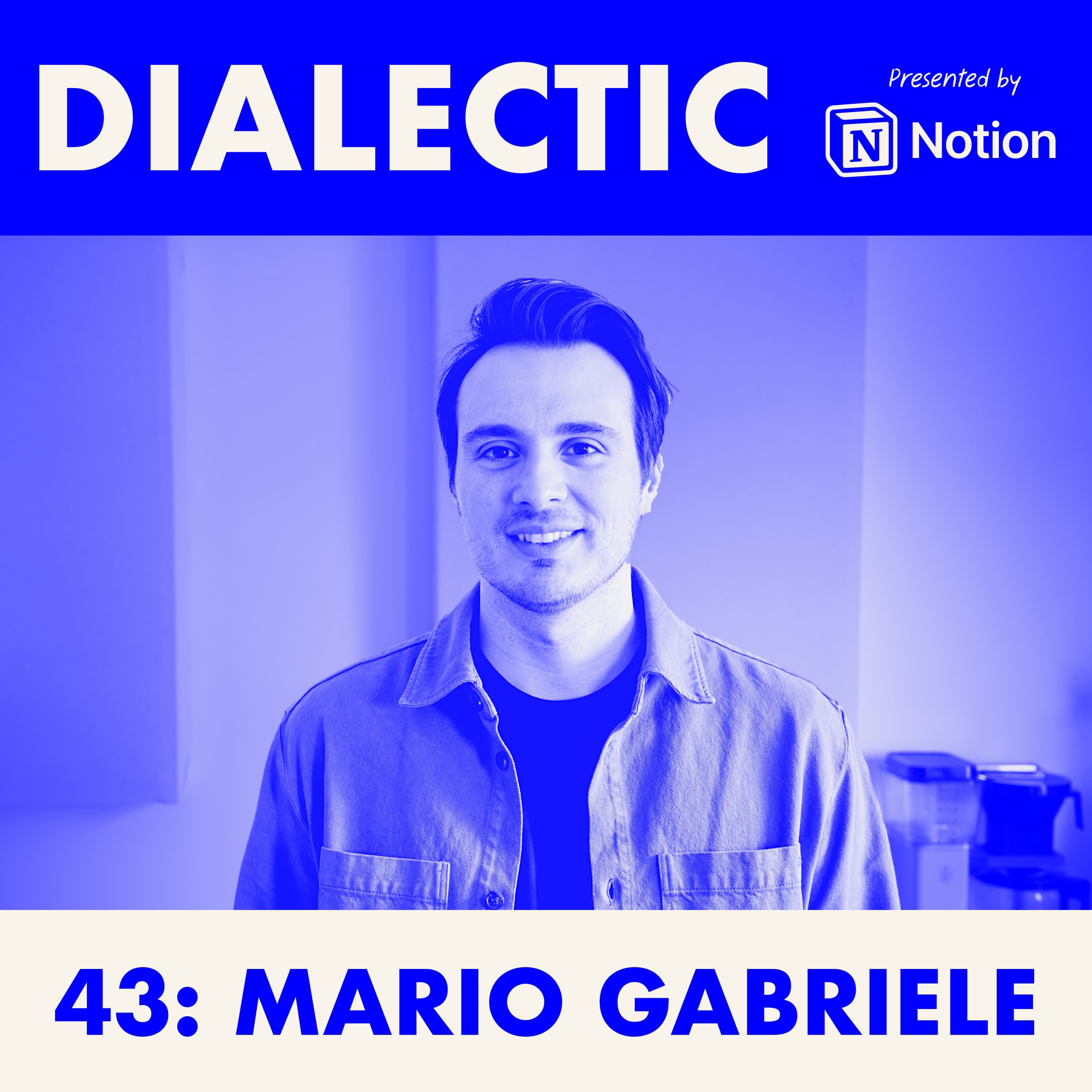
Dialectic 43: Mario Gabriele - Reality is Story-Shaped
20 Lessons from Mario on Storytelling, Authenticity, and Finding the Shape of What’s True
Stories are how our minds transmit truth. Religions run on them. Political systems hold because of them. Mario says stories are “many orders of magnitude more durable and magnetic than anything else we can come up with.” It’s not an objective reality, it’s a species-subjective one. Our brains are wired this way, and the best we can do is work with that wiring.
Beware the axis between madness and greatness. Mario is drawn to the sacrifice, discomfort, and psychic weirdness that often sit behind elite performance. His conclusion? Hero and villain are often just two edits of the same raw material.
A polished story is a suspicious story. If someone narrates themselves too neatly, Mario starts wondering what has been cut for elegance, the photographic negative. Every story has a surface and a shadow, a told version and an untold one. The job of an investor, a writer, anyone paying attention is to find what’s left unsaid.
Great writing is obsessive observation. It means observing a feeling or event with such fidelity that you make the comparison no one else saw coming: “almost like a joke, you need that element of surprise.” The dominant advice in tech is really just copywriting: hooks and lists useful for distribution. The people giving writing advice in the attention economy are not the people doing the best writing.
Beware phrases that sound wise on contact. Mario’s hatred of “How you do anything is how you do everything” is really a broader warning about faux-wisdom. Some sayings have the rough shape of wisdom and none of the calories, yet still manage to plant a malware in your head.
Design the game around your one thing. Peter Thiel’s core lesson at Founders Fund: find your comparative advantage at the expense of everything else. Mario’s is serious literary skill crossed with founder obsession and tech + venture rigor. Pair that with a gift for connecting disparate threads and you have something unique.
No excuses, no costume, no cover. The things that brought Mario closest to authenticity had a common structure: situations where there was nobody else to rely on. Failure in an exchange year in Nepal. Wild success building the Generalist. You don’t think your way to knowing yourself. Instead, you discover it by putting yourself in positions where you either rise to the occasion or drown.
Birth is always painful. Mario agonized over starting the Generalist. He asked for advice, deliberated, vexed, when he could have just tried. “Action produces so much information.” The crossing is never comfortable, but the information is on the other side.
It’s okay to be a white belt in life. Mario’s way of reading people is to enter with childlike openness and a willingness to inhabit another’s perspective. Present as the student and the teacher emerges.
Show up like an athlete. Lots of investors drift into meetings default skeptical or half-present. Mario treats founder conversations like a performance: when the pistol fires, how you’re feeling is irrelevant. You don’t know who’s walking through the door. It might be the most important meeting of someone’s year (or yours).
Raise someone’s ceiling before they can. Being the first check is less about the money and more about being the first person to say: I see ten times more in you than you see in yourself. You’re the boatman taking them across the river. They’d have made it anyway, but you pulled them forward.
The best judgments fit on a napkin. If your investment rationale gets too long and too convoluted, suspicion should rise with every added sentence. Sometimes the clearest case is simply: this person is special, and that brevity is not laziness but earned compression.
Footnote the last best thing you wrote. Mario doesn’t chase subscribers. There’s a tradeoff between popularity and influence, and he chooses the latter, even if it means a smaller audience. His goal each year is to write one piece that makes the last best thing he wrote a footnote.
Kill things before they kill you. The Generalist has cycled through formats, business models, cadences, and entire community experiments. Mario is comfortable killing things early. The sacred part has never changed: obsessive care about the sentences, flow, and story.
Pay the debt to modernity. Mario spent ten years believing great work would find its audience on quality alone. It doesn’t work that way. Every writer, no matter how literary their sensibility, owes a concession to the distribution mechanics of their time, however romantic the alternative sounds.
There is always the game and the metagame. Mario says it’s happening in every conversation: even a podcast, even with the people closest to you. “It sounds cynical, but I don’t think it has to be. It is there all the time, whether you see it or not.”
The texture of someone’s mind matters more than the spreadsheet. Too much time is spent on CAC, LTV, and product features, and too little on who someone actually is. Hummingbird’s chief focus is creating the conditions for founders to open up and reveal the strange, raw edges of their personality.
Happy childhoods don’t build world-beaters. Mario is skeptical of the “good fuel” framework. Behind every hyper-ambitious person, there’s something unresolved. Even founders who claim perfect childhoods reveal fractures on closer inspection. You can’t trust the narrative because greatness tends to take everything.
Generosity is the sign of true quality. Not gradients. Not dark mode. Not the aesthetic preferences of a high-signal group. Real quality in a product or a piece of writing is meeting someone where they are. Most things marketed as “delightful” just flatter the people already in the room.
You don’t have to know what you’re becoming. Mario will always love writing, stories, and studying the strange people tech produces. But he won’t lock himself into a form factor. Oscar Wilde’s line captures it: if you never settle on who you’re supposed to be, you never become anything. That’s the reward.
Description
Mario Gabriele (X) is a writer, investor, and analyst. He is founder of The Generalist and Partner Hummingbird.
He aims to bring the rigor of investment analysis with writing quality and style that is closer to the New Yorker. His profiles, deep dives, and briefings are amongst the highest quality writing in the technology business, and he interviews practitioners weekly on his podcast. Recently, he wrote the definitive (and nearly book-length) piece on Peter Thiel’s legendary investment outfit, Founders Fund, and profiled Microsoft’s Satya Nadella.
I spoke to Mario about stories and the truths they hold or reveal. He is a writer first, and it shows in his prose, style, and depth. We also discussed the evolution of The Generalist’s content and business model, both of which he has experimented with ruthlessly. The subscription counts 160,000+ readers / listeners and is currently ranked as the #7 bestseller in Substack’s business rankings. He is also an investor focused on the technology world’s heroes: founders. Hummingbird, which he joined earlier this year, is known for its obsessive approach to understanding the minds, motivations, and worlds of the entrepreneurs it backs. We dive into the under-discussed elements that shape world-beaters, including the notion that ambition almost always comes from some level of pain.
Across the conversation, we talk about how authenticity and evolution run across his career, and how he is at peace as someone who doesn’t know exactly who he is becoming. That generalist orientation continues to produce unlikely paths that surprise him. I hope this conversation inspires you to take stories seriously, to look for what’s true beneath the polished surface, and to trust paths you didn’t plan for.
Dialectic is presented by Notion. Notion is an AI-powered connected workspace where teams think together and create their best work. Notion recently launched custom agents: helpful AI teammates that handle recurring work across your entire suite of tools. Automate you and your team’s repetitive tasks so you can focus on the deep work. You can learn more at notion.com/dialectic.
Timestamps
(0:00) Opening Highlights
(1:13) Intro to Mario
(2:49) Thanks to Notion
(3:58) Start: Stories, Truth, Writing, and the Story Beneath the Story
(23:39) Failure, Authenticity, Comparative Advantage, and The Most Annoying Aphorism in the World
(35:55) The Generalist’s Style
(45:20) Process, Goals, Vision, Experimentation, and Business Models
(57:52) Investing: Energy, First Checks, Notecard-level Clarity, and Peter Thiel
(1:07:46) Understanding Founders, Motivation, Good and Bad Fuel, and True Ambition
(1:17:47) Hummingbird: Seeing the World as it Actually Is and How Stories Reveal Truth, Linguistics, Observation, Deciding to Join, and Evolution
(1:29:32) Motivation, Raising the Bar, Ongoing Learning and Teachability, Status, Unlearning, Generous Products, and The Reward of Not Knowing
(1:47:15) Thanks Again to Notion


