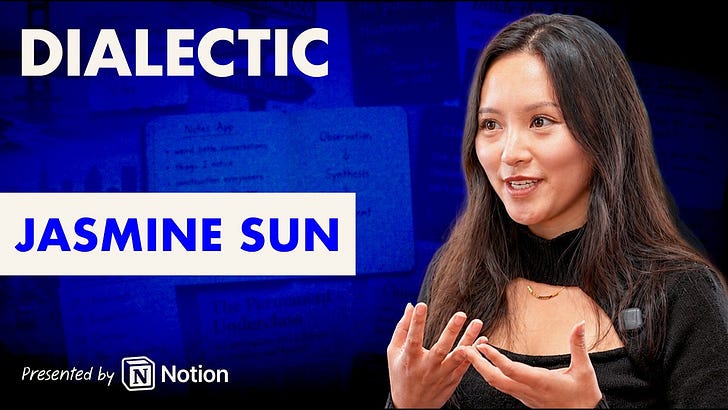
Nicole Seah, aka Nix, has become someone I look forward to long, grounding, and inspiring walks with. I’m excited to share one of our conversations with you.
She writes essays at her newsletter, starting from nix, invests in early-stage startups, and recently launched new ontologies, where she writes independent field studies of ambitious founders and companies.
We talk about what beauty asks of us, the freedom of holding multiple identities, and loving what's real. I’ve also shared 20 favorite ideas from the episode below.
Full episode here on Substack and on Spotify, Apple, YouTube, and X. Transcript and all links here. Please share it if you enjoy it!
Dialectic Ep. 46: Nicole Seah (Nix) - Loving What is Real
20 Lessons from Nicole on Difficult Beauty, Doomed Commitments, and the Slow Harvest of a Self
Beauty is unselfing. Nicole starts with Iris Murdoch’s idea that beauty takes you out of the private drama of yourself. The standard version asks, how do I exert more effort to be more glamorous & beautiful? The deeper version makes you more generous and open to the world.
Tolerate strangeness long enough to be changed by it. Some beauty doesn’t open on first contact. Nietzsche on difficult music: you have to bring “goodwill, patience, reasonableness, and gentleness” before the unfamiliar removes its veil. Most great works have a learning curve to them.
Return to what snags. Nicole’s filter for difficult art: if you feel nothing, move on. But abrasion, irritation, resistance, emotional static — those are signals you have felt something. Return to it.
Borrowed eyes still count. I sometimes worry that needing a critic, friend, or teacher to unlock a work of art feels like cheating. Nicole’s counterpoint: attention is communal. Sometimes another person’s perspective is not a crutch but the portal that teaches you how to see.
Reality is better than your fantasy. Nicole is drawn to characters who chase glory, discover the mirage, and still return to the flawed human world. The dream may be cleaner, but reality has bodies, aging, crumbling buildings, courage, fervor, and the rude advantage of being true. “There are no more fantasies to cling onto. Only forward into the night, led by the beacon of beauty.”
Don’t be afraid to introduce new colors. Nicole’s art teacher says a painting could be richer with different colors, and Nicole just tries it. That scene explains her worldview: defensiveness keeps the work from growing; openness lets the world add a color you could not yet see.
Salvation comes from extreme and doomed commitments. That’s Joan Didion. When an interviewer asked if she really thought her commitments—marriage, children, and writing—were doomed, she said no, she thought they were salvation. Both, then. Always both.
Playfulness emerges from intensity. Alyssa Liu floats across the ice because muscle memory is carrying her through a decade of grinding. Miyazaki watches eels wriggle in a restaurant tank to figure out how a dragon should move. The lightness on the surface is paid for in obsession underneath.
Show up for yourself like you would a friend. You trust friends who show up when they said they would. So show up for the page, the reps, the appointment with yourself, and don’t let yourself down the way you wouldn’t let a friend down.
You are allowed to be illegible. Writer, investor, painter, reader, friend, technologist: Nicole does not force the selves into one clean, readable LinkedIn headline. Some identities arrive early, some go dormant, and some you harvest much later. Tend to your garden of selves patiently.
Do not turn your gift into a cage. Nicole cares deeply about writing, but rejects “writer” as a primary identity. Better: creative aliveness, the cycle of discovery, collection, synthesis, and expression that can serve every other life you are building.
The work is the maker, distilled. Rebecca Solnit: underneath the task of writing the piece is the longer task of making the self who can write it. Nicole sees the same pattern in companies: the best ones smuggle the lineage of their founders inside. Every little pattern carries the fingerprints of the person who made it.
Convergence takes grace, not pressure. You can’t force ikigai. You can only stay patient enough to deserve it. Monet painted water lilies 250 times. Sarah at Ando needed a first company to learn what shape a second one should take from her actual gifts, not the gifts other people had in mind for her. You can’t force the parts of yourself into one shape on a timeline.
Get to the question under the question. We meander, stacking softer questions on top of the real one until we eventually arrive. Nicole’s rule: skip the climb-down and just say the thing underneath. It’s great for everything — business, personal relationships, all of it. The person on the other side is usually relieved you went first.
Find inspiration through witness. Watching a friend apply quiet effort for years until it finally works is the cure for being intimidated by their finished product. Up close, excellence stops looking like genius and starts looking like force applied at a very specific angle, which means it’s available to you, too.
Mystery is part of intimacy. Greg Egan’s Closer is about a couple who try to fully merge minds and discover that the mystery between them was the thing keeping them in love. A friend or lover is precious not because they become fully knowable, but because they remain capable of surprising you.
Soul resonance survives distance. Her best friend Justine lives in London and they see each other in person maybe once a year. They don’t have much surface area, but they have density. Once you understand someone’s character — what they’re on earth to do — the bond is hard to sever.
Notice the interrelationships, not the things. Nicole’s gloss on George Saunders’ idea of the supra-personal — not interpersonal, not super-personal, but the space between. Noticing deeply means tracking the relationships you form with what you read, make, or meet, and how those relationships generate new internal worlds.
Signpost the peaks and the troughs. Nicole documents euphoria and listlessness by writing so she can remember that neither is permanent, and that she can’t completely control things. By remembering the peaks during troughs, she can be motivated to climb again.
Burn the candles. The well refills. Annie Dillard: “Anything you do not give freely and abundantly becomes lost to you. You open your safe and find ashes.” Creatives hoard sentences, ideas, encounters, thinking they’ll be used perfectly later. But Ursula Le Guin says love is like bread, made new every day — and so is creativity. The deeper you go, the richer it gets. Use every good sentence you have now.
Description
Nicole Seah (X, Substack, LinkedIn), aka Nix, is a writer at Starting From Nix and investor at Costanoa Ventures. She recently launched New Ontologies, where she profiles founders and companies thinking ambitiously about the future. Her first piece is live now, on Ando: the team building a chat platform for the era of agents.
Nicole balances identities with poise, moving between the literary and the practical. I spoke to her about different kinds of beauty and how it takes us out of ourselves, Nietzsche’s case for tolerating strangeness, and choosing reality over fantasy. Then we discuss duality and balancing intensity and lightness, and talk through Borges, Hesse, Miyazaki, Alyssa Liu, and Joan Didion. Nicole argues that freedom comes from not collapsing yourself into a single identity. I asked her about the drive behind New Ontologies, her obsession with techne, and Rebecca Solnit’s “cosmology of self.” We then skate across a range of ideas, including memory, appetite and desire, and friendship and why other people’s unknowability is part of what makes them wonderful.
I hope this conversation inspires you to look for and love what is real, to be patient with and attuned to the multiple people inside you, and to give freely of your creative life.
Full transcript and all links and references: dialectic.fm/nix.
Dialectic is presented by Notion. Notion is an AI-powered connected workspace where teams think together and create their best work. Notion recently launched custom agents: helpful AI teammates that handle recurring work across your entire suite of tools. Automate you and your team’s repetitive tasks so you can focus on the deep work. Inside Notion by Brie Wolfson & Camille Ricketts for Colossus. You can learn more at notion.com/dialectic.
Timestamps
00:00 - Opening Highlights
01:14 - Intro to Nicole
02:04 - Thanks to Notion
03:48 - Start: Beauty — Effort, Attention, Strangeness
19:59 - Fantasy and Reality
29:41 - Multiple Identities, Intensity, and Lightness
49:08 - New Ontologies: Profiling Founders Building the Future
1:08:57 - Memory, Lineage, and Process
1:18:41 - Appetite and Honesty
1:23:47 - Friendship, Proximity, and The Unknowability of the Other
1:41:18 - Closing Notes: Solitude, Noticing, and Generosity
1:53:40 - Thanks Again to Notion