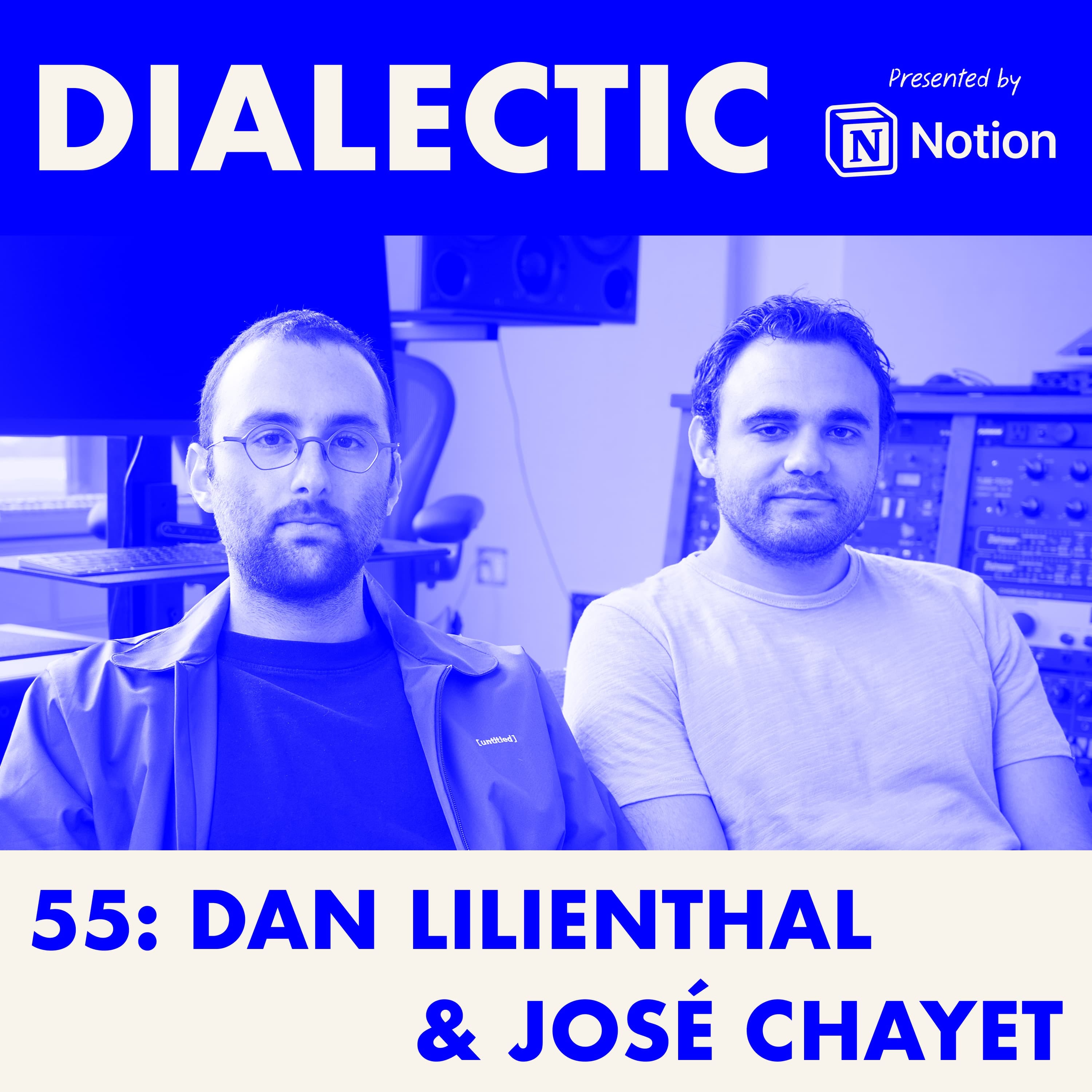
Dan Lilienthal and José Chayet run [untitled], a sacred place for work-in-progress music.
They aren’t trained engineers, designers, or musicians, and yet have built a platform that hundreds of thousands of artists—from 16-year-olds on their first record deal to Lorde—use to store, listen to, and work with their music.
Lorde also recently released XRAYS on [untitled]: 49 demos, the sonic museum behind her album Virgin.
Dan & José are also childhood best friends. I talked to them about the adventure so far and their quest to build the biggest music company in the world.
Available on all platforms: transcript/links, Spotify, Apple, YouTube, [untitled], X/Twitter.
Dialectic 55: Dan Lilienthal & José Chayet - As [untitled] as it Comes
18 Lessons from Dan and José of [untitled] on Unfinished Songs, Sacred Software, and the Sophomore Album
Creativity makes the world bigger. José’s benchmark for novelty is what he felt in Copenhagen in 2006, standing under a shower where the water fell from the ceiling. The best music, design, and technology expand what seems possible: “This was the world, and now the world just got a little bit bigger.”
Music is AR, not VR. Much of entertainment is escapism: it takes you elsewhere. Music deepens your experience of where you already are. You can see your own life through a new lens. It’s an overlay, not an exit.
The divine can sound like your friend’s demo. A friend described music as the way most humans connect with the divine. For Dan, that connection is most vivid in José’s music, because it connects him to the things his friend is feeling, and taps into something deeper than himself.
Creation is becoming a series of choices. José connects Duchamp’s found objects to sampling and found sounds in music: over time, creation concentrates in curation and context. AI is only accelerating this. “What do I want? What do I see? What do I want to see?”
The idea never wavered. Everything else had to. They wrote the V1 spec in a single day in 2020 and essentially shipped that document three years later. In between came money raised, a few hundred users, and a decision to restart the team from scratch in New York. “It was an execution story.”
Find the person upstream of the ecosystem. Music is a pyramid with the artist at the top: producer, manager, A&R, and publicist all serve whatever the artist wants. One producer admitted to José he doesn’t even like the app, but a big artist insisted he use it. Every category has a central character: GitHub won the engineer, Figma won the designer. Their preferences organize everyone else’s behavior.
Fake your way into real empathy. They were not professional musicians, engineers, or pixel-level designers, so they decided to become “method actors.” They made music, studied artists and products obsessively, and treated empathy as a discipline you can practice rather than a credential you’re born with. A big musician’s verdict: “It’s as if you’re in our brains and you know exactly what we want.”
One primitive can serve 16-year-olds and superstars. A kid on their first record deal and Lorde both want listening to their own music to feel as good as Spotify. Thoughtful and simple design choices can scale if they meet universal needs.
Discovery doesn’t always need to be efficient. Unfinished music is sacred, so [untitled] began with intimacy and has resisted the reflex to build a feed, even six years in. Even the most prolific artists “are still very shielded,” so “you have to start from a place of privacy.” Music spreads person to person through iMessage and WhatsApp instead of an algorithm. And the discovery that does happen is slow and physical: most of the music Dan finds now arrives through whoever walks through their studio: “This building is my algorithm.”
A peek behind the curtain can make a fan. José thought the Beatles were plain until Get Back made him ask, “Why does anybody else even make music?” Lorde’s demo drop on [untitled] sent Dan back to an album he’d barely played. Context draws us in, but you have to earn the right: nobody visits the museum of a nobody.
Alignment is the best marketing. Other music companies run campaigns about how much they care about artists. [untitled] charges artists for a product they keep choosing to pay for. Dan: “The thing that keeps the lights on is making sure artists love what you’re doing.”
Necessity is the mother of recruiting. Neither founder is technical. They once flew hours for dinner with an engineer while pretending they were already in town; Dan approached strangers in Swift shirts on the subway and coders at WeWork. A missing capability can force you to become unusually resourceful at attracting it.
QA is the job. They can spend a day arguing over 30 versions of one experience. José says QA has “always been the most important function” they’ve performed. As AI increases everyone’s output, this is only accelerating. Now, the challenge is scaling this intuition and filter beyond just the two of them.
“AI” is a big tent. Everyone assumes AI in music means generative songs from products like Suno. They are excited about tools that help artists explore references and search enormous archives of works in progress.
The scarce ingredient is surprise. Earlier AI models created stranger music. Now, they sound “better” but are predictable: “It’s too good. It’s too good.”
Every artist is trained on someone. They asked a legendary artist about AI models training on his catalog. His response: “I trained on other people’s music.” As for what’s next, he admits he hasn’t made anything with AI that he couldn’t have made otherwise… yet.
Work with someone who makes you feel like a kid. Dan thinks creativity depends partly on childlike curiosity, and working beside the friend he has known since childhood keeps silliness, inside jokes, and play within reach. “It’s almost like a hack to tap into your childlike creativity.”
Reinvent between records. Fifty thousand paying customers, $5M in ARR, and building the thing they dreamed up. But the next phase will look different. Dylan went electric. “It’s time to make the sophomore album and make the next big one.”
Description
Dan Lilienthal (X, LinkedIn) and José Chayet (X, LinkedIn) are childhood friends and cofounders of [untitled] (X, Instagram), a platform for musicians that they describe as a sacred place for work-in-progress music. It is where a song lives between recording and streaming. [untitled] is closer to the Photos app than to a social network: a private place to store, listen to, and slowly share demos, with no feed.
Dan and José are not trained musicians, engineers, or designers, but they have built a product artists love by “method acting” their way into deep empathy. The platform has grown to 50K paying users and now allows artists to share unreleased music directly with fans. Lorde recently released XRAYS on [untitled]: 49 demos and works in progress from her album Virgin, creating a kind of museum behind the record.
We discuss music as a form of communication and a connection to the divine; why they have resisted adding a feed; product inspirations like the iPod and Snapchat; how empathy and QA underpin their product philosophy; designing for 16-year-olds and superstars; AI as an instrument; which parts of the creative process are worth sharing; what it means for software to be sacred; and building a company with your best friend.
I hope you’re inspired to consider what is sacred, share and live with the things you make, seek out music that inspires you, and stay untitled a little longer than is comfortable.
Dialectic 55: Dan Lilienthal & José Chayet - As [untitled] as it Comes
Dialectic is presented by Notion. Notion is an AI-powered connected workspace where teams think together and create their best work. You can learn more at notion.com/dialectic.
Timestamps
(0:00) Opening Highlights
(1:24) Intro to Dan & José & Thanks to Notion
(4:42) Start: Brackets, How Creativity Makes the World Bigger, and Music’s Connection to the Divine
(20:40) Duchamp, Music as a Set of Choices, and The Museum Behind the Work
(27:52) [untitled]: A Medium for Music In-Progress
(45:03) From a Better Dropbox to a Creativity Company
(52:13) Empathy as a Product Philosophy and The Collaboration’s Origins
(1:01:04) Scaling the Sacred Place and Product Intuition
(1:10:33) Lorde’s XRAYS Drop and Designing for a Wide Range of Artists
(1:17:26) 10K Unheard Songs and Whether Process Should be Seen
(1:24:10) Brand, Trust, Alignment with Artists and the [studio]
(1:30:54) The Word “Sacred” and Resisting the Feed
(1:40:52) AI as an Instrument: Building Tools Artists Actually Want
(1:49:27) Building a Company with Your Best Friend
(1:56:31) Closing Questions: Dream Users, Rapid Fire Brackets, and Titles
(2:08:52) Thanks Again to Notion