


Brie Wolfson is someone I’ve long admired from afar and heard amazing things about from friends like Tamara Winter. She also wrote one of my favorite and the more resonant things I read last year when she “profiled” one of my heroes, Kevin Kelly. It’s not as much a profile as it is an essay on her experience in Kevin’s presence, and how he embodies a different kind of approach to navigating and an unlikely and authentic life.
I finally got to spend a little time with her late last year and then made the journey out to Seattle for this conversation. Brie is so energetically infectious and generous that I flew back to NY with my cup overflowing. I hope you feel the same way. As usual, I’ve included some favorite lessons from her below, too.
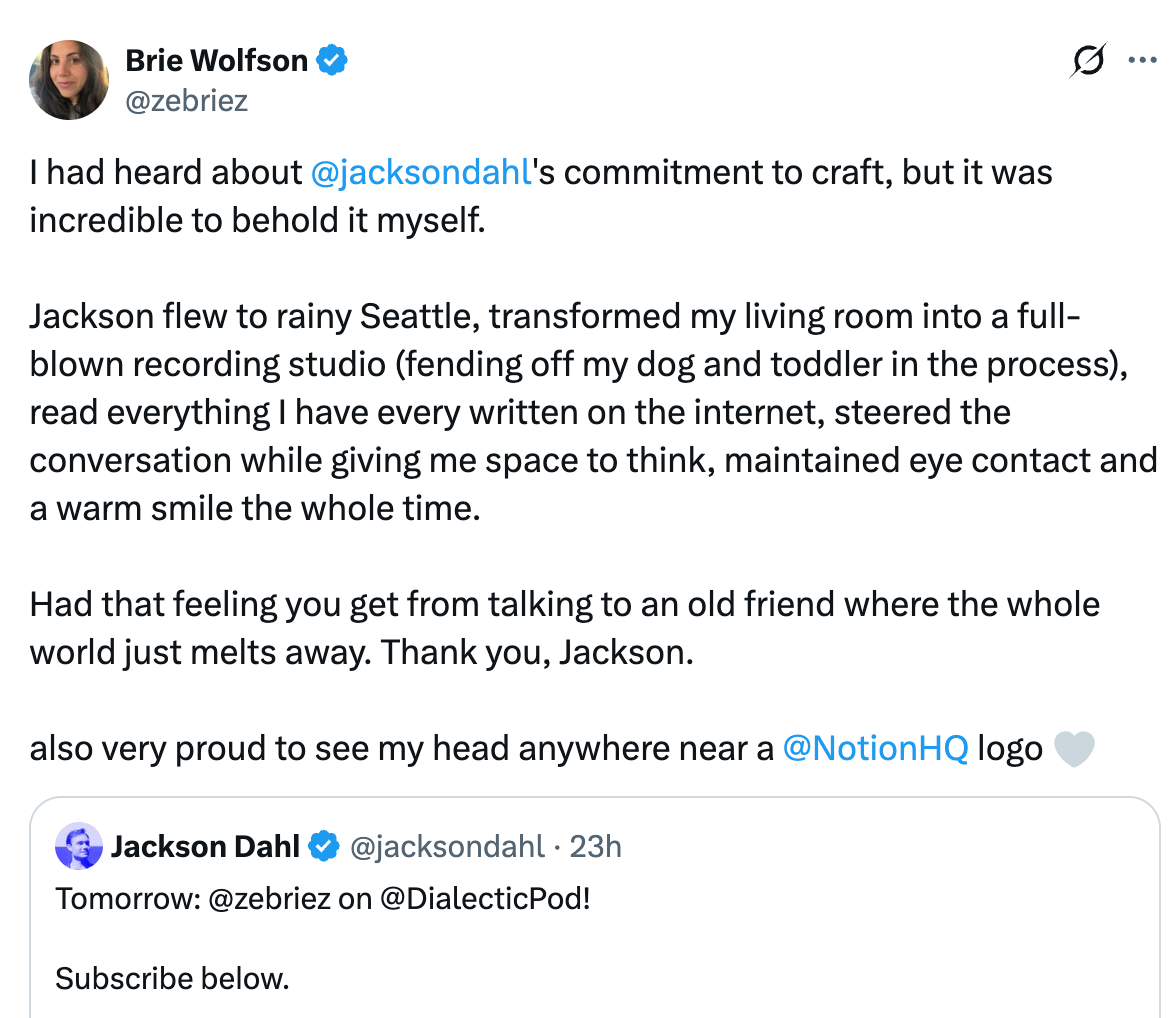
Selfishly, I also have to share Brie’s little note reflecting on our time together, which made me smile big:
Please enjoy!
Dialectic Ep. 35: Brie Wolfson - Loving Attention & Ease in Craft
Dialectic Episode 35: Brie Wolfson: Loving Attention & Ease in Craft - is available on Spotify, Apple Podcasts, and YouTube, and all podcast platforms.
17 lessons from Brie Wolfson on craft, culture, and doing work that’s useful and joyful
Finger feel only comes from reps. Craft comes from time spent at the ground level, close to the details. You can’t think your way there; you slug it out until your hands know before your brain does. Eventually, that produces the taste we associate with unconscious competence.
The best leaders are not t-shaped, but fork-shaped. Great leaders roam wide and dive deep across domains. They’ll help with copy edits, rebuild a pitch deck, or debug hiring loops without losing altitude. Nothing slips by them because they refuse to delegate understanding.
Loving attention beats LGTM culture. “Looks good to me” means your work was skimmed. Loving attention means someone catches the typo, pushes back on lazy phrasing, and makes your work sing. Most feedback is drive-by. Find the people who care enough to push you.
Good marketing is truth-telling. People smell bullshit instantly, so honesty is the only strategy that scales. The trick is working for underrated companies where there’s rich space between what’s true and what the world knows. If there’s no craft, product, or leadership underneath, there’s no story worth telling.
Great companies want to be great organizations. Stripe. Figma. Cursor. What do they share? “The only thing these companies have in common is that they aspire to be great companies themselves.” The quality bar doesn’t stop at the product, but extends to the organization itself.
Help people get to yes. Anyone can say no. But great editors know which dials exist to make something better. Don’t just mark it “not ready”—show the path to get there. Aim to really see the person and amplify them.
Zoom in with notes, zoom out with faith. Be a micro-pessimist and a macro-optimist. Tear into the details: the weak sentence, the wobbly logic, the half-baked concept. Then step back and protect the momentum. Good faith feedback preserves excitement. Pure pessimism kills the work before it has a chance to breathe.
Taste is more about appreciation than judgement. Notice how things are made. Why this layout feels right. Why that transition lands. The world is full of precious choices, and the best connoisseurs and curators find joy amidst discernment.
Work the crannies. The overlooked projects—the unloved docs, the in-between roles, the orphaned initiatives—hide leverage. Excellence at your core job buys you permission to explore and take risks.
Hold the skinny mirror. When you admire someone, your natural lens should make them look like a rockstar. The instinct to refract great people outward is generous.
Excellence is contagious. While the most exceptional people tend to shine early and anywhere, sometimes we have to see what great looks like to get closer to it. You might be sluggish in one environment and come alive in another. When you’re surrounded by people in their lane, you might want to join them.
Aim for ease in your craft. The goal doesn’t have to be fame or being remembered by history. It can be trusting yourself to produce excellent work, understanding your own worth, and having confidence without white-knuckling the process.
You can’t compete with somebody having fun. Genuine enthusiasm beats any top-down mandate. When someone believes the work rocks, they’ll run through walls for it. When it comes down as a directive, they’ll do the minimum. The best work feels like play.
Pay attention to personal clues. Understanding your actual motivations lets you make better decisions. Quiet the world so you can hear yourself, then write it down so there’s a record of what’s going on inside. Your patterns repeat, so you can ignore them or work with them.
Bring high and low together. The best taste combines intellectual depth with accessibility. Being polymathic lets you push on ideas from unexpected angles: serious substance meets pop culture, geopolitics bumps into Britney.
Asking for help is generous. Everybody likes to be thought of as being in the room where it happens. Be specific and bring people along on your journey.
The mud is where it gets real. Brie loves Marge Piercy’s poem ‘To Be of Use’: “The work of the world is common as mud. But the thing worth doing well done has a shape that satisfies.” A joyful life is about being useful—fixing things, using your hands, putting in more than you take out. Tool-using, problem-solving, being of service.
Description
Brie Wolfson (X) is a marketer, writer, storyteller, and curator. She’s Chief Marketing Officer of Positive Sum & Colossus, where she works closely with CEO Patrick O’Shaughnessy across investing and media and spearheaded Colossus Review, their new print publication known for superb long form profiles.
Brie also recently joined AI-programming behemoth Cursor as Head of Employee Experience and wrote about the company’s culture. She has worked with craft-oriented software companies throughout her career, including Stripe—where she helped launch Stripe Press and the company’s planning function, among other things—and Figma, where she worked on Education. In her words, she is drawn to companies where the reality is even more impressive than the reputation, and she has publicly and privately worked with a number of the most impressive leaders in Silicon Valley on marketing, culture, and storytelling.
We cover a broad range of Brie’s expertise, including craft, marketing, organizational culture, unlikely career paths, and taste, editing, and writing. This includes how AI is causing companies to become even more oriented around the empowered individual contributor and who the best of them, including company leaders, are focused on an attunement to details that she likens to “finger feel.” We also talk about why she believes marketing should be a kind of truth-telling, closing the gap between reality and perception. She also reflects on the common cultural thread of great companies: a deep-seated desire to be a great company, not just create great products. She talks at length about everything she’s learned from amplifying special people and how she’s navigated the tension in her own desires for fun and breadth and ambition toward greatness.
I hope this conversation inspires you to raise your standards, get to the ground level, and settle into a life of deep attention that produces quality, usefulness, and joy.
Full transcript and all links: https://dialectic.fm/brie-wolfson
Dialectic is presented by Notion. Notion is an AI-powered connected workspace where teams build their best work. Notion is also where I compile research for episodes and the home of my new site where you can find all links and transcripts. You can read more about why Notion embodies Dialectic’s values and our partnership announcement here. You can find the essay from Notion CEO Ivan Zhao mentioned at the end of the episode here.
Timestamps
0:00: Opening
3:54: Notion
5:04: Intro: Craft, Finger Feel, and Staying Closer to the Ground Level
13:27: Process vs. Output, Quality vs. Speed, and Great Editing
21:44: Craft, Substance, and Truth in Marketing
25:56: Individuals as the Building Block of a Company and Empowered ICs
32:02: Creative Collaboration and In-Person and Remote
36:46: Company Building: What is Changing and What Will Stay the Same
44:25: The Soft Stuff: Great Company Values and Great Culture
52:17: Thinking vs. Doing Cultures, 996 and Difficulty Sitting Still
1:00:37: Morale, Fun, Amplifying Leaders, and Loving Attention
1:11:58: Career Path Advice for Young People
1:19:56: Kevin Kelly, Chasing Greatness, Illegibility, and Ease in One’s Craft
1:27:29: Special Talent and Contagious Ambition
1:32:22: Brie’s Spike: Charisma, Hard and Soft, Making Things Fun, and Belief
1:43:23: Taste, Appreciation, Generosity, Skill and Soul
1:57:26: Great Editors, Saying No and Getting to Yes, and Being Receptive to Editing
2:05:25: Great Writing: What do You Have the Right to Do that Others Don’t?
2:13:55: Grab Bag: Optimism and Pessimism, High and Low, and Closing Maxims
2:30:07: Thanks to Notion


